48 Hours in Athens sounds like a rather ambitious assignment for a city that has spent roughly three thousand years accumulating temples, ruins, Byzantine churches, Ottoman traces, neoclassical mansions, political arguments and places insisting that their grandmother makes the definitive version of moussaka. Fortunately, central Athens works surprisingly well for a short visit. Most of the essential sights sit within walking distance, assuming you accept that Athens occasionally interprets the word “walking” as “climbing a steep hill under Mediterranean sunshine”.
The trick is not to treat Athens as an archaeological obstacle course. Yes, see the Parthenon. Obviously. But also drink coffee in a square where nobody appears remotely interested in classical civilisation, wander through a food market, get lost in Anafiotika, eat far more than planned and watch the Acropolis turn gold after sunset. Athens works best when ancient history becomes part of the scenery rather than homework.
Day One Morning: Start at the Acropolis Before Everyone Else Has the Same Idea
Begin your 48 Hours in Athens at the Acropolis. There is no clever alternative here. Putting it off until later merely means spending half the day looking up at it while pretending you have deliberately prioritised something else.
Go early. Athens becomes extremely warm for much of the year, the exposed rock offers limited shade and the marble underfoot can become surprisingly slippery. The Acropolis also feels far more impressive before enormous tour groups start marching through the Propylaea behind guides holding coloured umbrellas.
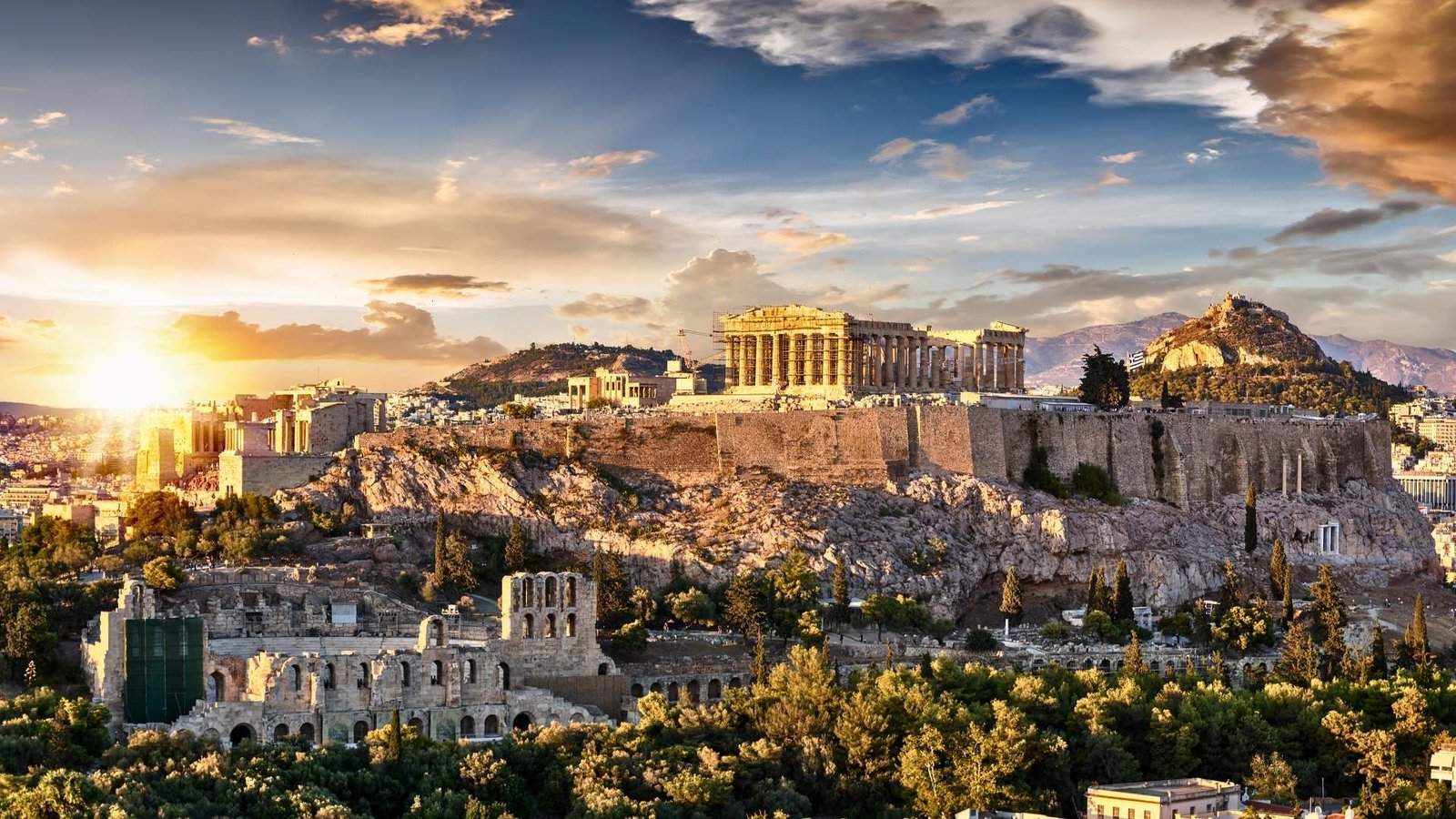
Walk up through the monumental Propylaea and suddenly the Parthenon appears. Photographs prepare you for its shape but not its scale. Ictinus and Callicrates designed it in the fifth century BC during the age of Pericles, and somehow the building still dominates Athens despite missing rather significant portions of itself.
Take time with the Erechtheion nearby. Its Porch of the Caryatids looks wonderfully elegant, although the figures standing here are replicas protecting the originals from pollution and weather. The Temple of Athena Nike occupies a smaller but strategically dramatic position near the entrance. From the walls, Athens spreads towards mountains and sea in a great white urban carpet.
It is tempting to spend all your time photographing the Parthenon from seventeen slightly different angles. Resist. Walk around, look at the details and occasionally put the phone away. Civilisation somehow managed to appreciate the place before portrait mode.
Down the Hill to the Theatre of Dionysus
Rather than heading directly into Plaka, follow the southern slope past the Odeon of Herodes Atticus. Built in the second century AD, this Roman theatre still hosts performances, which feels rather more dignified than turning every ancient building into a gift shop.
Continue towards the Theatre of Dionysus, where classical Athenian audiences watched works by Sophocles, Euripides, Aeschylus and Aristophanes. It represents one of those places where the phrase “historic venue” seems laughably inadequate.
From here, join Dionysiou Areopagitou, the broad pedestrian promenade curving around the Acropolis. Street musicians appear, locals walk dogs and the Parthenon remains above you like an architectural supervisor checking progress.
The Acropolis Museum Without Archaeological Fatigue
The Acropolis Museum stands almost opposite the southern entrance to the archaeological site and makes the obvious next stop. Its glass floors reveal excavations beneath the building, immediately establishing that in Athens even constructing a museum can uncover another layer of Athens.
Inside, the displays put the ruins you have just seen into context. The Caryatids stand here at eye level, while sculptures from temples and sanctuaries reveal just how colourful and elaborate ancient Athens once looked. The Greeks did not actually spend their lives surrounded by tasteful white marble. Ancient temples originally featured strong colours, which probably comes as upsetting news to several generations of minimalist interior designers.
Save the top-floor Parthenon Gallery for last. Architects aligned it with the Parthenon itself, allowing you to look from surviving sections of the frieze towards the temple they once decorated.
Lunch and the Alleys of Plaka
By now archaeology has earned you lunch. Head into Plaka, the old neighbourhood pressed against the northern and eastern slopes of the Acropolis.
The main lanes can become extremely touristy, complete with souvenir shops selling enough miniature Greek helmets to equip a moderately sized plastic army. Ignore the worst offenders and slip into the side streets around Tripodon, Lysiou and Kidathineon.
For a straightforward traditional lunch, look for one of the quieter tavernas away from the busiest streets. Order a Greek salad, grilled aubergine, tzatziki, courgette fritters, gigantes beans, lamb or grilled fish. Ordering several dishes “for the table” remains one of Greece’s more civilised contributions to human happiness.
After lunch, wander uphill into Anafiotika. Builders from the Cycladic island of Anafi constructed this tiny quarter during the nineteenth century, and its whitewashed houses, narrow stairways and splashes of bougainvillea feel astonishingly island-like considering that the Parthenon sits practically overhead.
There is no important monument demanding your attention here. That is precisely why Anafiotika works. Wander, get mildly lost and eventually emerge somewhere downhill.
Roman Athens, Monastiraki and the Ancient Agora
Continue towards the Roman Agora and the Tower of the Winds, an octagonal marble structure that functioned as a combination of sundial, weather vane and water clock. Apparently the ancient Athenians also wanted one device to do everything.
A few minutes later you reach Monastiraki Square, where Athens becomes dramatically louder. The Acropolis rises behind the domed Tzistarakis Mosque while trains rumble into the station, souvenir sellers negotiate, street performers perform and somebody inevitably attempts to sell you sunglasses.
From Monastiraki, enter the Ancient Agora. This deserves far more attention than many short itineraries give it. The Agora formed the political, commercial and social heart of classical Athens. Socrates walked here. Citizens debated politics here. Traders sold goods here. People complained about public life here. In other words, civilisation has changed less than we imagine.
The reconstructed Stoa of Attalos now houses the Museum of the Ancient Agora, while the Temple of Hephaestus stands remarkably intact on the western edge. Give yourself enough time to wander rather than rushing through purely to tick it off.
Sunset from Philopappos Hill
Cross towards Thissio and walk up Philopappos Hill before sunset. The path winds through pine trees towards the Monument of Philopappos, but the real reward appears when you turn around.
From here you see the Acropolis almost face-on, separated from you by greenery rather than traffic. As the sun drops, the marble changes from pale cream to honey and eventually glows against the darkening city.
This viewpoint costs nothing and requires no rooftop reservation, dress code or cocktail costing more than lunch. Athens does occasionally offer bargains.
Walk downhill through Thissio for dinner. The pedestrian strip along Apostolou Pavlou offers constant Acropolis views, while Psyrri, a little further north, provides a livelier evening scene.
Night in Psyrri
Finish your first day around Iroon Square in Psyrri. The neighbourhood combines old workshops, bars, restaurants, murals and narrow streets that become progressively more animated as the evening develops.
Do not hurry dinner. Greeks certainly will not. Order meze, grilled meat or seafood, add wine or ouzo and accept that your original plan to have “one quick drink afterwards” may lack credibility.
Before returning to the hotel, walk through Monastiraki once more. The illuminated Acropolis floating above the square provides the sort of view that encourages perfectly sensible adults to take another twenty photographs of exactly the same building.
Day Two Morning: Athens Before the Ruins
Your second morning starts somewhere far less polished: Varvakios Central Market on Athinas Street.
This enormous meat, fish and produce market shows Athens conducting ordinary daily business with considerably more noise than the Parthenon. Fishmongers shout prices, butchers work behind counters, herbs hang outside specialist shops and stalls overflow with olives, cheeses and produce.
Walk along nearby Evripidou Street afterwards. Shops here specialise in spices, cured meats, dried fruit, herbs, cheeses and various mysterious ingredients that may cause you to reconsider travelling with hand luggage only.
Stop for Greek coffee. Proper Greek coffee arrives small, strong and with enough sediment at the bottom to conduct geological analysis. Do not drink the last mouthful unless you particularly enjoy chewing beverages.
Through the Commercial Centre to Syntagma
Walk south through the historic commercial centre towards Ermou Street. The architecture becomes more formal as you approach Syntagma Square, the political centre of modern Greece.
At the top stands the Hellenic Parliament, formerly the Royal Palace. In front lies the Tomb of the Unknown Soldier, guarded by the Evzones of the Presidential Guard. Their uniform, including pleated fustanella skirts and pom-pommed shoes, attracts plenty of cameras, but the ceremonial role carries genuine historical significance.
The changing of the guard takes place regularly throughout the day, with a larger ceremony on Sunday mornings. Even the standard change makes an entertaining pause, partly because the slow, highly controlled movements look unlike anything normally associated with military efficiency.
The National Garden and Zappeion
Walk behind Parliament into the National Garden. Queen Amalia commissioned the original Royal Garden in the nineteenth century, and today it provides a welcome green break from Athens’ stone, traffic and enthusiastic use of car horns.
Follow the paths past palms, ponds and shaded corners towards the Zappeion, the grand neoclassical building linked with the early modern Olympic movement.
This section of the itinerary deliberately slows down. Forty-eight hours need not mean marching continuously. Sit for coffee. Watch the parrots that have somehow established themselves in central Athens. Consider that they have probably chosen better winter accommodation than most Europeans.
Marble Glory at the Panathenaic Stadium
From the National Garden, continue to the Panathenaic Stadium, also called Kallimarmaro. The stadium occupies an ancient sporting site but took its present marble form during nineteenth-century reconstruction ahead of the first modern Olympic Games in 1896.
Its long horseshoe of white marble makes an extraordinary sight. Walk onto the track and climb into the seats for views towards central Athens. The scale becomes more obvious from the upper rows, although reaching them provides an authentic reminder that ancient Greek athletic culture involved considerably more exercise than watching sport on television.
The stadium also marks the finishing point of the Athens Marathon, following a route associated with the legendary run from Marathon to Athens. Anyone who has walked extensively around the city during August may already feel qualified.
Lunch Around Pangrati
Instead of immediately returning to tourist Athens, wander into Pangrati. The neighbourhood spreads behind the stadium and feels more residential, with bakeries, cafés, small restaurants and local squares.
Find somewhere serving cooked daily dishes rather than chasing another grand “Greek dining experience”. Try gemista, vegetables stuffed with rice and herbs; pastitsio, Greece’s magnificent answer to the question of whether pasta requires more béchamel; or slow-cooked lamb with potatoes.
A two-hour lunch would not constitute poor itinerary management here. It would constitute cultural research.
Museums or More Streets?
The afternoon presents a choice.
If classical sculpture still excites you, head towards the National Archaeological Museum. Its collections extend well beyond Athens and include the Mask of Agamemnon, Cycladic figurines, bronze sculpture, Mycenaean treasures and works covering thousands of years of Greek civilisation.
If another museum threatens to turn ancient masterpieces into vaguely remembered marble objects, stay outdoors instead. Walk through Kolonaki, one of central Athens’ more polished neighbourhoods, pausing at cafés and shops before turning uphill.
Because there is, naturally, another hill.
Lycabettus for the Grand Finale
Lycabettus Hill rises high above central Athens and provides perhaps the city’s finest panoramic viewpoint. You can climb through the pine-covered slopes or use the funicular for much of the ascent. After nearly two days of walking, nobody gets extra cultural points for refusing mechanical assistance.
At the summit stands the small white Chapel of St George. Beyond it, Athens spreads in every direction: the Acropolis below, mountains enclosing the basin and, when the air cooperates, the Saronic Gulf glinting in the distance.
Come before sunset and stay as the lights appear. From up here the city suddenly makes sense. The apparently chaotic streets flatten into neighbourhoods, hills and monuments. The Acropolis, which has followed you around for two days, becomes one luminous landmark among millions of modern lights.
It makes an appropriately theatrical ending.
Athens After Forty-Eight Hours
The great advantage of 48 Hours in Athens lies in how easily the city mixes eras. You can stand beside a fifth-century BC temple in the morning, eat lunch beneath a nineteenth-century house, pass a Byzantine church after coffee and spend the evening in a graffiti-covered bar without travelling more than a few kilometres.
You will leave plenty unseen. Kerameikos deserves more time. So do Exarchia, the National Archaeological Museum, the Byzantine and Christian Museum, the Benaki Museum and the coastal neighbourhoods stretching towards Piraeus. Cape Sounion and the Temple of Poseidon warrant another half-day altogether.
But forty-eight hours gives you Athens’ essential rhythm: ancient stones before breakfast, strong coffee, markets and neighbourhoods in between, enormous lunches and hills at sunset. The gods may have departed Olympus, philosophers no longer argue in the Agora and democracy has acquired considerably more paperwork, but Athens still possesses a magnificent talent for making history feel like part of everyday life rather than something locked behind museum glass.