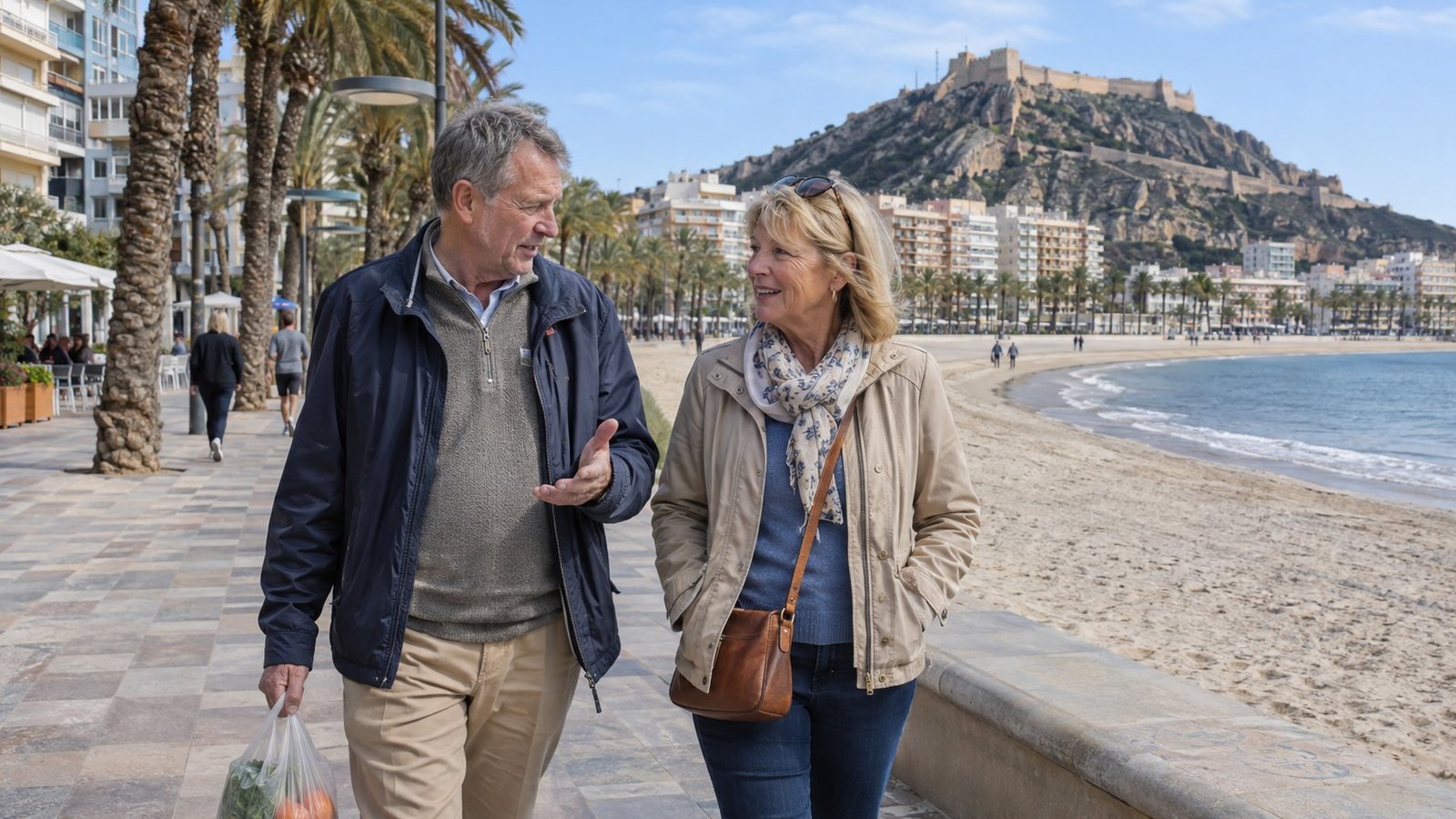
Alicante makes moving abroad look suspiciously straightforward. There is a beach beside the city centre, a market selling things you actually want to cook, and enough pavement cafés to turn a minor errand into an afternoon. For someone contemplating another British winter, the argument practically writes itself. Yet choosing a permanent home requires different questions from choosing a hotel. Can you legally stay? What happens to your pension and healthcare? Will the flat still feel comfortable in August? Alicante offers a convincing setting for everyday life, provided you investigate the everyday part as thoroughly as the Mediterranean view.
First, distinguish Alicante city from Alicante province. An advertisement promising “Alicante living” might describe somewhere requiring a car for nearly everything. Mercado and Benalúa offer an urban routine of local shops, apartment buildings and journeys on foot. Playa de San Juan provides a different balance, with a long beach, residential developments and tram connections whose usefulness depends on the precise address. The old town supplies atmosphere, slopes and opportunities to learn exactly how late other people enjoy themselves. For a permanent move, a lift, decent insulation and a nearby supermarket may contribute more happiness than a charming balcony above a bar.
Housing also challenges the old assumption that Spain automatically means cheap. Idealista’s October 2026 asking-rent index puts Alicante city at €13.80 per square metre monthly: roughly €970 for a hypothetical 70-square-metre flat. Individual properties can differ substantially, and advertised prices do not establish what tenants ultimately pay. As an illustrative planning exercise, a couple might start with €1,800–€2,400 monthly for modest rented living without a car, private schooling or substantial insurance premiums. Build your own budget from actual listings and quotes, then allow a reserve. If your income comes in pounds, exchange-rate movements become part of the household rather than an occasional holiday irritation.
Read rental terms carefully, particularly when a furnished flat looks unusually affordable. Some properties offer temporary accommodation and expect tenants to leave before the lucrative summer season. Ask explicitly for a home suitable for year-round residence and check the contract’s purpose. Inspect cooling, ventilation, winter heating and noise rather than admiring the tiles exclusively. Buying deserves even more patience: commission independent legal checks on ownership, debts, planning and community charges before committing money. Spain ended new investor-residence applications in April 2025. A property purchase therefore provides somewhere to put your furniture, without independently providing permission to remain beside it.
For most British citizens moving now, residence requires planning before departure. The usual visa-free allowance covers up to 90 days in any 180 across the Schengen area; it does not provide a settlement route. Britons whose residence falls under the Withdrawal Agreement have a different position, as may people with an Irish or another EU passport or qualifying family rights. For a new applicant relying solely on British nationality, the appropriate route depends on whether you intend to retire, work, study or join family. An estate agent’s confidence about how everyone manages should never substitute for the relevant immigration requirements.
Retirees and others living without employment may consider the non-lucrative residence route. It prohibits work and requires sufficient resources, qualifying healthcare cover and supporting documents. The financial threshold starts at 400% of Spain’s IPREM indicator, plus 100% for each dependant; check the applicable amount when applying. Remote workers need a different conversation. Spain’s international teleworker route has requirements concerning overseas work, qualifications or experience, income and social security. A British employer’s permission to work from Alicante does not settle those obligations. Anyone seeking local employment should establish work permission first and assess opportunities realistically: Spanish considerably broadens a search beyond English-speaking tourism and hospitality roles.
The paperwork continues after immigration approval. You will encounter the NIE, your foreigner identification number; the TIE, the residence identity card relevant to many British residents; and the padrón, the municipal register. These serve different purposes, despite sometimes appearing interchangeable in enthusiastic online advice. Expect appointments, supporting evidence and, where required, apostilles and sworn translations. Keep organised copies and follow the requirements for your particular route. If driving forms part of the plan, current guidance allows UK licence holders to drive for six months after becoming resident, after which they need a Spanish licence. Start the exchange process well before the deadline.
Healthcare deserves a place near the beginning of the move. British residents who work and contribute to Spanish social security generally access public healthcare through that system. Eligible UK State Pension recipients may obtain an S1, which they must register in Spain. Others may need comprehensive private insurance, particularly for their residence application; check exclusions, existing conditions and cover at older ages before choosing a policy. A GHIC covers eligible temporary visits and does not replace arrangements for permanent residence. Alicante belongs to the Valencian health system, so completing the local registration matters as much as identifying your underlying entitlement.
Retirement brings a reassuring point and a less entertaining spreadsheet. The UK State Pension receives annual increases for eligible recipients living in Spain, but a pension paid in sterling must still meet bills in euros. Tax needs separate attention. Spending more than 183 days in Spain during a calendar year can establish Spanish tax residence, while the centre of your economic interests can matter too. Spanish residents generally face taxation on worldwide income, subject to treaty provisions and applicable exceptions. Review pensions, investments, UK rental income and company interests before moving. The existence of a double-taxation treaty does not remove the need to understand declarations and liabilities.
Families should investigate schools before allowing a beautiful flat to decide the address. Spanish and Valencian feature in the regional education system, and families need to check the actual provision at individual schools. International schooling can add substantial fees and a school run that changes the economics of a supposedly walkable life. Adults have their own language decision. English helps with some services and social circles, but Spanish makes healthcare appointments, tradespeople and neighbourhood friendships considerably easier. The province’s established British communities can offer useful support, although Alicante city should not be mistaken for an English-speaking enclave with better weather.
Finally, test the seasons and the ordinary routine. A mild winter afternoon says little about an unheated bedroom, while summer nights reveal the value of shading and reliable cooling. Check flood exposure at the precise address, and remember that June’s Hogueras celebrations bring noise as well as spectacle. Alicante works particularly well for people with a viable residence route, dependable income and an appetite for outdoor city life. Try it through shopping trips, appointments and journeys home after dark. The useful question is whether you enjoy being there when nothing special is happening, and when the council needs another document.
Post Comment