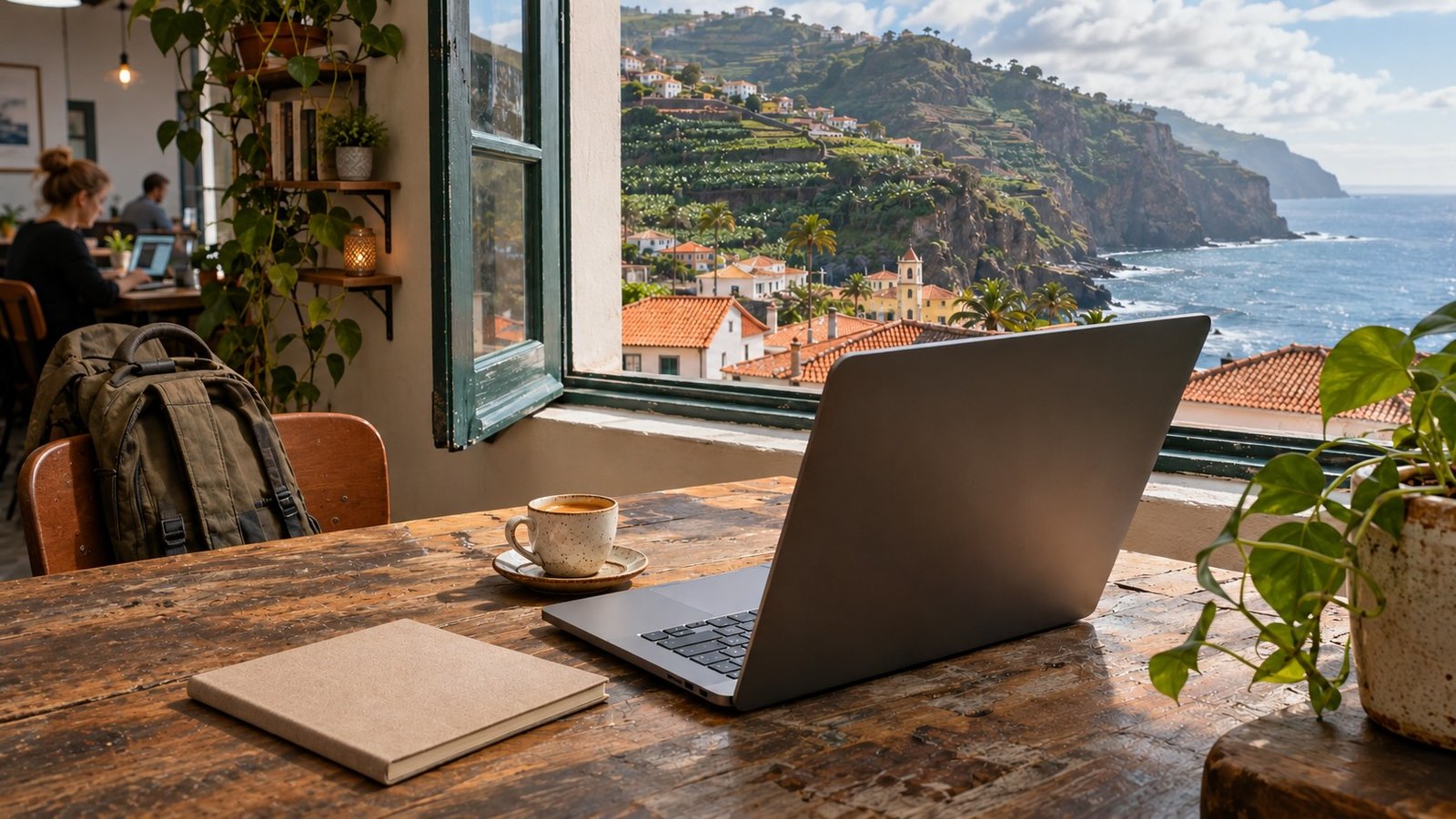
In Ponta do Sol, a small town on Madeira’s south-west coast, the price of a desk can be zero. The price of a front door is another matter. Since February 2021, the town has hosted a project that gives remote workers somewhere to work and a way to meet people. That makes Madeira a good place to spend a working month, particularly for anyone who spends the rest of the year on British hours. Whether it makes sense for six months depends on two less photogenic details, the lease and the right to work from Portugal.
The clever bit about the Nomad Village is that it takes care of a problem that good Wi-Fi cannot solve. When you move somewhere alone, you can spend the whole week talking to people on screen and still have nobody to go for dinner with on Friday. Startup Madeira’s project offers a free workspace in Ponta do Sol and runs or promotes events where newcomers can meet other remote workers. The desk gives people a reason to turn up on a Tuesday, when there is no welcome party and everyone has work to do. Repeated encounters are how a temporary address starts to feel like somewhere you live.
Ponta do Sol makes sense if that ready-made social life is a big part of the appeal. Funchal, the island’s capital, is the better first base for someone who wants to see what everyday life on Madeira feels like. It has its own nomad community, alongside the shops, services and bus connections that matter once the novelty of working with an ocean view has worn off. Within Funchal, it pays to look at the route between the flat and the places you’ll actually use. A supermarket ten minutes away on the map can feel considerably further away on the way home with the shopping. Madeira’s gradients put a different value on a ground-floor flat.
Machico offers a third option. It has a sandy beach, a quieter town centre and a place in Startup Madeira’s network of remote-working communities. It suits someone who would happily trade some of Funchal’s choice of restaurants and workspaces for a swim or a walk on the seafront after work. Where you live also determines how often you’ll want a car. Central Funchal is the easiest place to start without one. From a smaller town, check the actual bus timetable for the journeys you expect to make, especially in the evening. A cheap flat can lose some of its advantage if every social plan comes with a taxi fare.
Housing is where Madeira can surprise people who still think of Portugal as an inexpensive place to rent. In October 2026, property portal Idealista put Funchal’s advertised rents at €16.50 per square metre, up 4.1 per cent on a year earlier. At that rate, 50 square metres comes to €825 a month. It’s a useful benchmark for comparing listings. A furnished flat available for precisely one month is a different proposition, and the figure tells you little about what you’ll pay for flexible dates, bills and a place you can move into with one suitcase. Price the actual dates before deciding whether the free desk makes the trip affordable.
The clock is one thing a British remote worker can simply leave alone. Madeira keeps the same time as the UK, so a nine o’clock meeting remains a nine o’clock meeting through the seasonal clock changes. The broadband question needs a more local answer, ideally a recent speed test from the room where you plan to work. Ask about upload speed if your day involves video calls or large files, and find out whether you can get a mobile signal indoors. A dining chair looks perfectly adequate in an accommodation photo. By Thursday afternoon it may have become the most consequential item in the flat.
The paperwork deserves the same attention as the accommodation. For British passport holders without EU residence or other applicable rights, the Schengen allowance of 90 days in any 180 governs short visa-free visits. Permission to work remotely is a separate question, so check the rules for your planned stay with the Portuguese authorities before booking. Portugal has a temporary-stay visa route for remote work for up to a year and a residence route for longer stays. The latter is designed for people employed by a company outside Portugal or working for themselves, with an income requirement tied to four times the Portuguese minimum wage. Anyone planning a longer stay should also check with their employer and establish how the move would affect tax and social security.
The weather is a good reason to try Madeira in the first place, provided you choose your part of the island with your intended routine in mind. The south coast generally runs warmer and drier, while the mountains can be cool and misty when the seafront is in sunshine. That gives a weekend some variety. So does the ability to finish work and go straight out for a walk by the sea, a smaller pleasure that may prove more valuable than the ambitious weekend itinerary you drew up at home. For a winter stay, ask about heating and ventilation in the actual flat. The temperature on a holiday website is usually measured outdoors, where you won’t be spending six hours on calls.
For a first stay, I’d choose Funchal, find a flat with a proper desk and spend a working day in Ponta do Sol. Anyone moving chiefly for company might reverse the experiment. Either way, judge the place on an ordinary working week, with the usual meetings and a shop to do, rather than on a Saturday in the mountains. Madeira makes a persuasive case for itself on Saturdays. The more revealing test is whether, when a meeting ends early on a wet Wednesday, you know where to go and who might be there.
Post Comment